An automatic retractable hose reel looks simple from the outside: pull out the hose, stop at the required length, use it, then give it a controlled pull and the hose returns into the housing.
But several mechanical systems need to work together to make that process smooth and reliable.
Inside a typical retractable garden hose reel, the main functions include:
- storing mechanical energy as the hose is extended;
- holding the hose at the required working length;
- releasing the lock when the user wants to retract it;
- rewinding the hose with controlled force;
- guiding the hose back onto the internal drum;
- maintaining a water connection while the reel rotates.
For homeowners, these mechanisms create convenience. For importers, distributors and private-label buyers, understanding how the system works is useful when comparing products, evaluating samples and discussing specifications with a manufacturer.
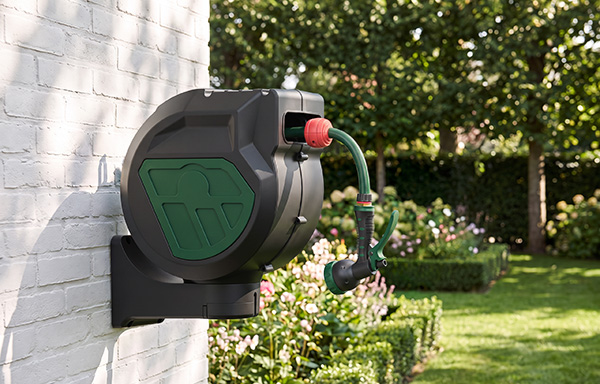
Quick Answer: How Does a Retractable Hose Reel Work?
A typical automatic retractable hose reel works through a spring-driven rewind system combined with a locking mechanism.
| Stage | What Happens |
|---|---|
| 1. Pull out the hose | The internal drum rotates and the spring stores mechanical energy. |
| 2. Stop at the required length | The locking mechanism holds the hose in position. |
| 3. Use the hose | The hose remains extended without continuous pulling. |
| 4. Pull again to release | The locking mechanism disengages. |
| 5. Hose retracts | Stored spring force rotates the drum in the opposite direction. |
| 6. Hose rewinds | A guide or reel structure helps the hose return into the housing. |
| 7. Retraction speed is controlled | On slow-retraction designs, additional control prevents excessively fast rewind. |
The important point is that an automatic hose reel is not simply “a hose with a spring.” The spring, drum, lock, guide, swivel and housing all need to work together.
The Main Components Inside an Automatic Retractable Hose Reel
Although exact designs differ between manufacturers and product series, most automatic retractable garden hose reels contain several basic systems.
1. Hose Drum
The hose is stored around an internal rotating drum. When the user pulls the hose outward, the drum rotates in one direction.
During retraction, it rotates in the opposite direction and winds the hose back into the housing.
Drum capacity needs to match:
- hose length;
- hose diameter;
- hose wall thickness;
- reel housing size.
This is why a 15m 1/2-inch hose reel and a 40m 5/8-inch reel cannot simply use the same internal structure.
The longer and heavier the hose becomes, the greater the demands placed on the drum and rewind system.
2. Spring-Driven Rewind Mechanism
The spring is one of the core components of a retractable hose reel. As the hose is pulled outward, rotation of the drum loads the internal spring.
When the locking system is released, the spring uses that stored energy to rotate the drum in the opposite direction.
That pulls the hose back into the reel.
The spring therefore needs to provide enough force to retract the hose, but the force should also be suitable for the length and weight of the hose.
- Insufficient force can result in incomplete retraction.
- Excessive force can make the hose return too aggressively.
- Inconsistent spring performance can produce uneven retraction.
How Does the Hose Lock at Different Lengths?
One of the most useful features of an automatic retractable hose reel is the ability to stop the hose at the required working length.
Without a locking system, the spring would continuously try to pull the hose back into the housing.
A typical retractable reel therefore uses a ratchet-and-latch or similar locking mechanism.
The user experience is simple:
- Pull the hose out.
- Stop at the desired position.
- Allow the lock to engage.
- Use the hose without holding tension against the reel.
How Does the Hose Start Retracting Again?
Once watering is finished, the user normally gives the hose another controlled pull.
That movement causes the locking mechanism to disengage.
Once released, the drum is free to rotate under the force of the loaded spring.
The hose then begins returning toward the reel.
What Is Slow Retraction and Why Does It Matter?
A strong spring can rewind a hose effectively, but uncontrolled retraction can create another problem: the hose may return too quickly.
A slow-retraction system is designed to control the rewind speed.
Instead of allowing the spring to retract the hose as quickly as possible, the mechanism moderates the return.
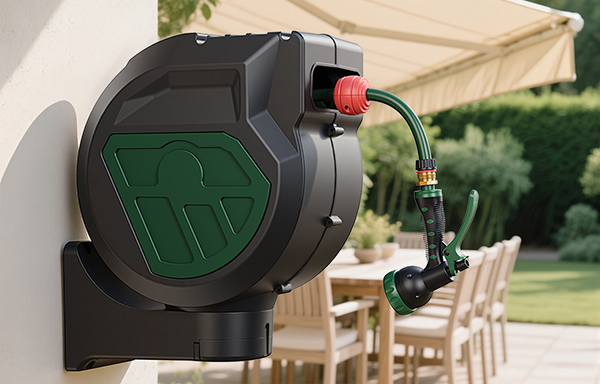
For buyers, slow retraction can be particularly relevant when positioning a hose reel as:
- a premium residential product;
- a convenience-focused product;
- a more controlled automatic reel;
- a product intended for frequent everyday use.
How Does the Hose Wind Back Neatly?
Retracting the hose is only part of the job.
The reel also needs to store the hose inside the housing without excessive tangling, overlapping or jamming.
Depending on the reel design, the internal structure or guide system helps manage how the hose winds onto the drum.
This becomes increasingly important with:
- longer hoses;
- larger hose diameters;
- heavier hoses;
- frequent extension and retraction.
How Can Water Flow While the Drum Is Rotating?
An automatic hose reel needs to perform two very different functions at the same time.
Mechanically, the drum needs to rotate.
Hydraulically, water still needs to move through the system without leaking.
This is where the internal water path and swivel connection become important.
The reel connects a stationary water inlet to a rotating hose drum.
Water source → inlet hose → fitting / swivel → reel hose → outlet nozzle
What Does the 180° Swivel Bracket Do?
The 180° swivel bracket often mentioned on retractable hose reel product pages should not be confused with the internal water swivel.
They perform different functions.
The external mounting bracket allows the entire hose reel housing to pivot from side to side after installation.
This gives the user more freedom to pull the hose in different directions.
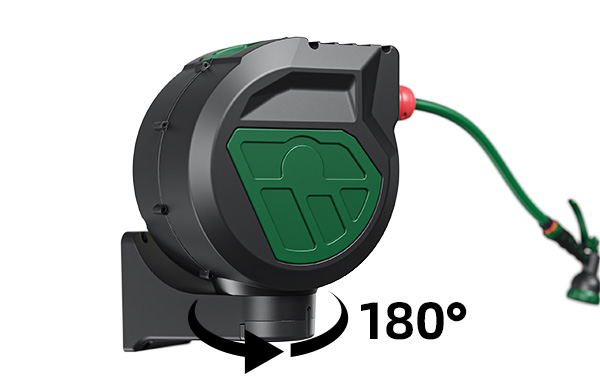
For example, the bracket can help the hose reach:
- the front garden;
- the side passage;
- the lawn;
- a driveway;
- areas around corners.
How Hose Length Changes the Rewind Mechanism Requirements
The same mechanism cannot be evaluated independently of hose length.
Consider the difference between:
- 15m × 1/2";
- 25m × 1/2";
- 40m × 5/8";
- 50m × 1/2".
These configurations place different loads on the reel.
A longer hose means more hose weight, more material on the drum, a larger drum or housing requirement and greater mechanical load during retraction.
Length, diameter and rewind design should be treated as one product system rather than three separate purchasing decisions.
What Should B2B Buyers Check in a Retractable Mechanism?
For wholesalers, importers and private-label brands, the question is not simply:
“Does it automatically retract?”
| Check | What Buyers Should Observe |
|---|---|
| Extension | Does the hose pull out smoothly? |
| Locking | Does it hold reliably at different lengths? |
| Release | Is the release action predictable? |
| Retraction | Does the hose return completely? |
| Speed | Is retraction controlled and comfortable? |
| Rewind consistency | Does performance remain similar at different lengths? |
| Hose management | Does the hose return without obvious tangling or jamming? |
| Noise | Is the mechanism unusually noisy during operation? |
| Bracket | Does the housing rotate smoothly without excessive looseness? |
| Swivel / seals | Is there leakage during rotation and use? |
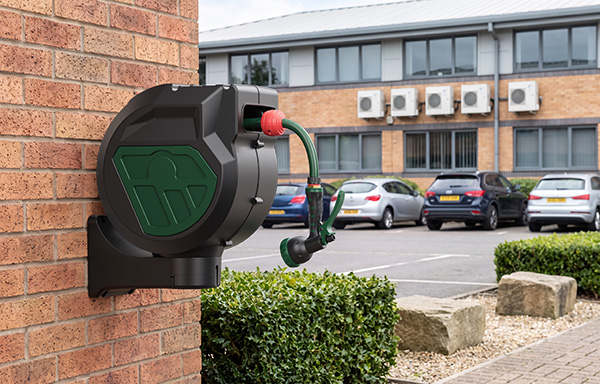
Why Retraction Testing Matters Before Mass Production
Automatic rewind is one of the most important selling points of a retractable hose reel.
It is also one of the functions consumers notice immediately if performance is inconsistent.
Useful questions include:
- Is the reel tested through repeated extension and retraction cycles?
- Is locking tested at different hose lengths?
- Is the hose fully retracted after repeated use?
- Is retraction speed checked?
- Are the spring and locking components inspected?
- Is the product tested with the final hose length and diameter?
- Is leakage checked while the reel is operating?
- Are sample results recorded before production approval?
Automatic Rewind vs Manual Hose Reel: What Is the Difference?
| Feature | Automatic Retractable Reel | Manual Hose Reel |
|---|---|---|
| Rewind | Spring-driven | User-operated |
| Locking | Usually integrated | Depends on design |
| User effort | Lower during storage | Requires manual winding |
| Internal mechanism | More complex | Simpler |
| Housing | Often enclosed | Can be open-frame or enclosed |
| Convenience | High | More basic |
| Engineering focus | Spring, lock, guide, speed control | Drum, crank and frame |
Common Factors That Affect Retraction Performance
From a purchasing perspective, buyers should understand that performance can be influenced by:
- spring quality and tension;
- ratchet or locking component wear;
- hose weight;
- incorrect hose length for the reel;
- debris inside the mechanism;
- corrosion;
- high or low temperatures;
- guide alignment;
- installation;
- long-term cycle fatigue.
What Specifications Should Buyers Send to a Manufacturer?
If you are sourcing an automatic retractable hose reel, providing a complete specification helps the manufacturer match the mechanical system correctly.
- target hose length;
- hose diameter;
- hose material;
- target market;
- connector standard;
- working pressure;
- mounting method;
- required locking function;
- slow-retraction requirement;
- housing requirements;
- target application;
- packaging;
- expected order quantity.
Frequently Asked Questions
How does an automatic retractable hose reel retract the hose?
The hose is normally wound around a rotating drum connected to a spring-driven mechanism.
Pulling the hose out stores mechanical energy in the spring. When the locking system is released, the spring rotates the drum and rewinds the hose.
How does a retractable hose reel stay at the desired length?
A locking mechanism, commonly based on a ratchet-and-latch principle or similar design, holds the drum in position when the hose reaches the required working length.
Why do I need to pull the hose again before it retracts?
The additional pull releases the locking mechanism so that the spring can rotate the drum and rewind the hose.
What is slow retraction?
Slow retraction controls the return speed of the hose so that it rewinds more smoothly rather than returning too aggressively.
Does a longer hose need a stronger rewind mechanism?
Longer hoses normally increase the amount of weight and material that the reel needs to manage.
The spring, drum and other components therefore need to be matched to the final hose length and diameter.
Is the 180° swivel bracket part of the automatic rewind mechanism?
No. The external 180° bracket allows the complete reel housing to pivot after installation.
The automatic rewind mechanism operates inside the reel housing.
What should B2B buyers test before placing a bulk order?
Buyers should check extension, locking, release, complete retraction, rewind speed, hose management, swivel sealing, bracket movement and repeated-cycle performance.
Understanding the Mechanism Helps Buyers Choose a Better Hose Reel
The convenience of an automatic retractable hose reel comes from several systems working together:
For professional buyers, a reliable retractable hose reel requires the correct balance between hose length, hose diameter, spring force, locking performance, rewind speed, hose management, sealing and structural strength.
Planning an Automatic Retractable Hose Reel Project?
For distributors, wholesalers, retailers and private-label brands, SUNWELL offers retractable hose reel configurations for North American and European applications.
Send your target hose length, hose diameter, market, connector standard, application, order quantity and packaging requirements to discuss a suitable configuration.
Request a Quote